How to Write a Python Developer Resume That Gets You Hired
22/06/2026
How to Write a Python Developer Resume That Gets You Hired
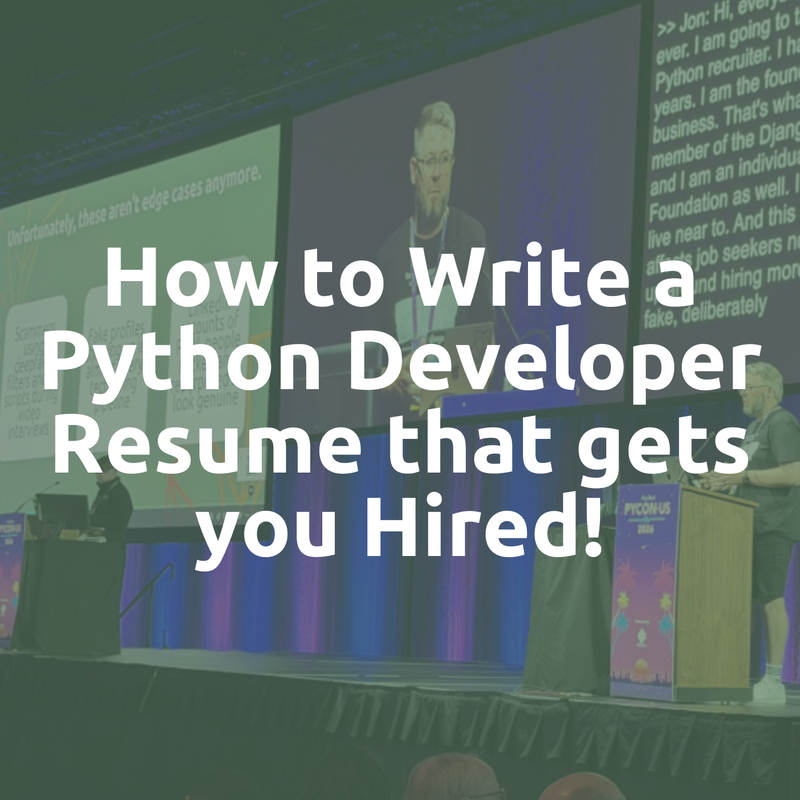
Whatever you call it, a CV or resume. This is how I'd write one that actually helps get you hired. I've been recruiting in the Python world since 2008. That's over 18 years of reading Python developer Resumes day in day out.
I've seen a fair few and I like to think that I know what works (and what gets skipped past in seconds) so here's how I'd put one together.

Start with your name and a headline
Keep the top simple. Your name, big and bold. Then give yourself a headline. A one line tagline that tells the reader who you are. "Django Developer looking for a new role." "Experienced Python Engineer." Something that is you in a single line.
Underneath that, give your key contact details. But don't put your full address on there. Nobody needs to know exactly where you live and if someone's sending you a contract it's going by email anyway. The key bits are enough. Include your City/Town/County/State though, people don't want to have to guess if you are local or in the same country. Leaving this off can cause suspicion and as I wrote about in my blog Tech Hiring has a FRAUD problem this could be seen as a red flag and may rule you out.
Under your contact details, link everything. Your GitHub, your blog, your website, your socials. Make it easy for someone to click through and see what you're about straight away.

Make your summary actually about you
Your summary is probably the first thing anyone reads. So don't waste it. Write in your own voice and don't be afraid to address an elephant in the room. This may just be an English phrase but I would want you to bring up any gaps in your work history, a career switch or anything else that is an obvious talking point in your background.
Avoid the generic lines like "A seasoned developer with X years of experience" "Adept at building high performance applications" Everyone writes things like that. The moment I read it my eyes glaze over, because I've seen it a thousand times and it just sounds like AI!
Write something that's actually about you instead. If you're active in the community or you contribute to open source, lead with that. If you've attended conferences, include this here and again later on. That's the kind of line that sets you apart from every other person applying for the same job.

List your work experience clearly
Latest job first. If you're still there, put "to present". If you've left, put the month you finished. It answers the obvious questions before anyone has to ask them.
For each role, list the key things you actually did. The projects and the work that mattered. Someone who's been somewhere a year won't have as much to say as someone who's been there eight. That's fine, just be clear. As you describe the work, name the technology you used at the time. Otherwise people could assume you haven't touched it. I also like to see a little tech stack in brackets at the end of each role, so there's no confusion about what you worked with where.
Keep education short and relevant
List the most recent and most relevant. If you've got a degree, put it down and link anything worth reading. A dissertation, a master's or a project someone can actually go and look at.
If your education stops at school, put it in, but don't stress about it. You'll be judged on your work experience, not your exam results.
Add a skills matrix
I like seeing a skills matrix. List the key things you've worked with across your career, especially the ones that show up in the job specs you're going for. Then show your depth.
I'd use years for this. "Python, 6 years." It's a fair way to put it across. You can rate yourself out of 10 if you want, but your 7 might be someone else's 4, so years is clearer for everyone.
Show what you've done for the community
This matters more in our world than most. Python and Django are built on an open source ethos and communities, so show that you're part of it. This is also a great way to show that you are a real person, which the fakers can't. Here's a link to the lightning talk I gave in Athens at DjangoCon Europe and at PyCon US on this subject.

List any conferences or meetups you've been to. Any contributions to open source packages, whether that's a small bug fix or helped with a major release. Put down what you've done for other people, not just for employers. It separates you from others.
Haven't done any of that? Don't worry, you can list your own projects instead and if your GitHub is empty because you can't breach an NDA, own it - employers will respect that too. Just maybe think about building something in your own time that you can actually show.
Treat your Resume as a live document
This is the big shift from tradition. A Resume now is a live document and sent electronically so it should be full of links that take people off to see your actual work.
Have you ever given a talk? Link it. Let someone click through and watch you on a stage giving your take on something...

I've seen this work first hand. I once told someone to put a link to a talk they gave at a Django Event at the top of their CV. The founder of the company watched it before the first interview and they got offered the job!
Another developer got a call back purely because a recruiter spotted a music link on their Resume and LinkedIn and, in her words, "had to give them a call". This shows again why adding some personal stuff really helps!

Show a bit of personality
If you've got the space, list a few interests away from the computer. Climbing, running, a sport, whatever it is for you. You could even combine this with your conferences and community bits.
But give it some detail. Adding "I play golf to a 10 handicap and my favourite course is X" tells me far more than "I like the cinema". It's a small thing but it gives someone a reason to connect with you as a person, not just a list of skills.

A quick recap
- Keep the top clean and link your socials.
- Make the summary about you, not the same generic lines everyone else uses.
- Be clear about what you did at each job and the tech you used to do it.
- Show your community involvement.
- Treat the whole thing as a live document that sends people off to see you in action.
- Be a real person and show this with some personality!
FAQ's
How long should a Python developer Resume be?
One to two pages is plenty. Enough to cover your relevant experience and the tech you've used without padding it out. If you've been working a while, lean on your recent roles and keep the older ones brief.
Should I tailor my Resume for every job?
You don't need to rewrite it from scratch each time. Just make sure the skills and experience that match the job spec are easy to spot. A skills matrix is the quickest way to do that. If it's well written and you are applying for the same kinds of jobs you won't need to change anything.
Do I need a GitHub to get hired?
No. But having one helps, especially in the open source world, but it isn't a dealbreaker. If yours is empty because of NDAs, own it and link your own projects or a talk instead.
How much should I pay to have my Resume reviewed or written?
Only pay what you can afford, but be wary of people promising you interviews or guaranteeing being hired. That's impossible!
Check out our Career Review service where a Resume review will be conducted as part of the offering.
Looking for your next Python or Django role?
If you're a Python or Django Developer after your next move, get that Resume sorted and then take a look at our Jobs Page. If there's anything there that looks relevant, drop me a message and I'll review your Resume and discuss the role(s) with you.

